İçeriğe atla
LinePlanIndustrial Architecture

Advanced Planning & Scheduling (APS): Capacity, Inventory and Orders in One Plan

An industrial APS that schedules customer orders, machine capacity, raw/semi-finished material allocation, and shift calendars simultaneously. It models work centers, heat/coil sequencing, and setup rules in one optimization engine and dispatches approved schedules to ERP and MES.

01 — Stakeholder Value Matrix

Stakeholder & Operational Value Matrix

  • Planning Manager

    Operational Requirement: When order priorities shift or an unexpected machine breakdown occurs, updating spreadsheets manually takes hours and increases setup losses.

    Architectural Solution & Value: The scheduling engine recalculates feasible sequences within minutes and displays setup and due-date impacts side by side.

  • Production Manager

    Operational Requirement: Without standardized optimization rules for heat, diameter, coil, or product-family transitions across work centers, avoidable tooling and changeover stoppages occur.

    Architectural Solution & Value: Shift schedules are published per line and work center together with explicit product changeover and preparation durations.

  • Material & Warehouse Planning

    Operational Requirement: Releasing production schedules without verifying FIFO availability of semi-finished inputs (billets, parent reels) and packaging materials causes line-side material starvation.

    Architectural Solution & Value: During scheduling, FIFO warehouse stock and WIP buffers are checked automatically so missing components are flagged before release.

  • Sales & Order Management

    Operational Requirement: Inability to provide deterministic delivery dates (ATP/CTP) based on actual line load and real OEE speeds undermines delivery reliability.

    Architectural Solution & Value: Delivery commitments are calculated against current machine load and historical OEE speeds, creating an auditable promise record.

LIVE 3D WEBGL DIGITAL TWINS & ENTERPRISE MES SHOWCASE

Sector-Specific 3D Digital Twins, High-Bay 3D Warehouse, and 16-Screen MES Suite.

Inspect full-scale browser-native 3D factory digital twins, the 5,280-bin high-bay warehouse with 6+ months / 3–6 months / 1–3 months stock aging heatmaps, and the 16-screen enterprise MES suite in real time.

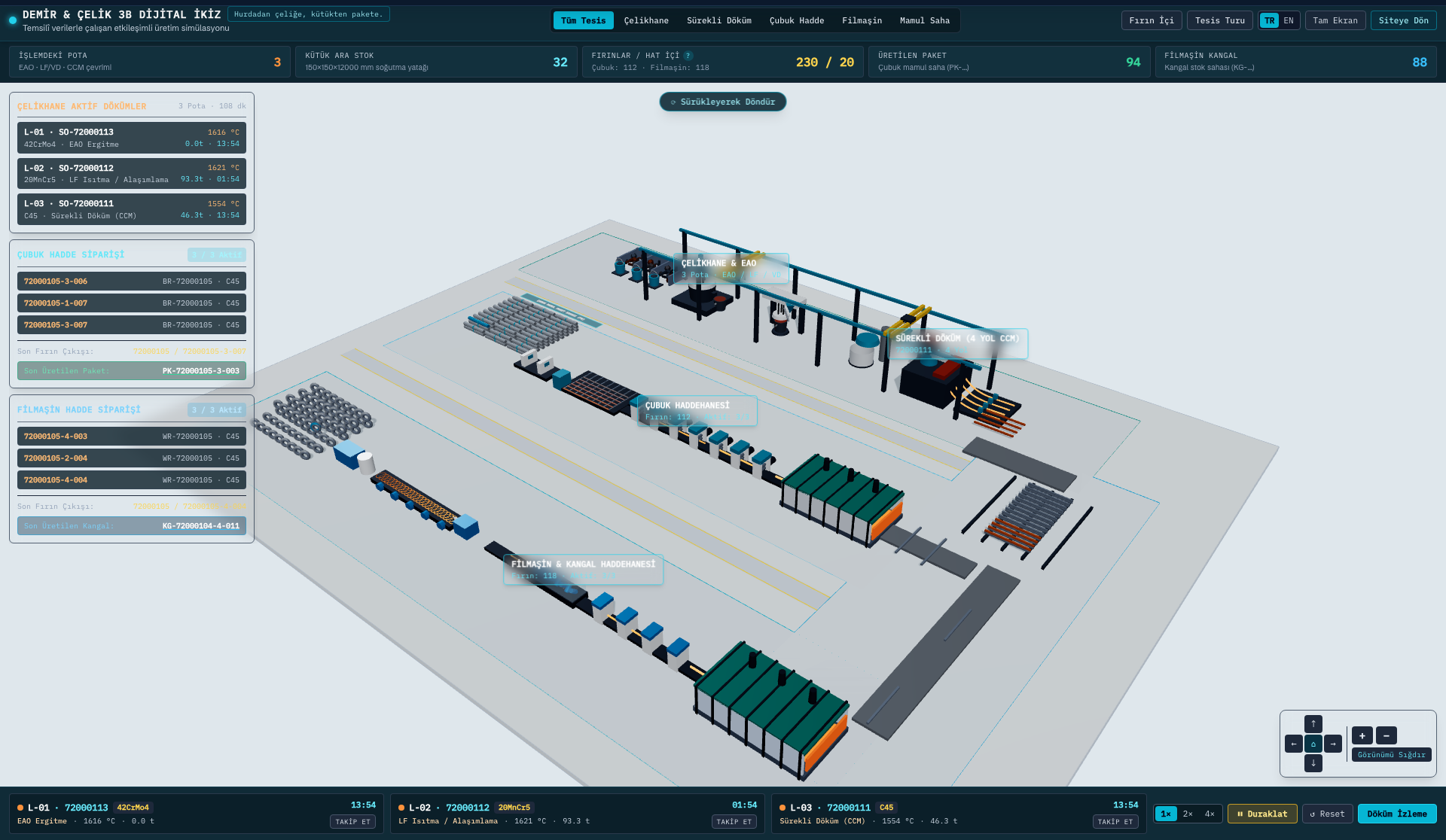
Iron & Steel Integrated Plant 3D Digital Twin
DIGITAL TWIN · 01Iron & Steel · Meltshop, CCM & 2 Rolling Mills

Iron & Steel Integrated Plant 3D Digital Twin

Full-cycle 3D simulation from scrap bays, EAF, Ladle Furnace (LF), Vacuum Degassing (VD), and 4-strand CCM to 112/118-billet reheating furnaces, Bar Rolling Mill (PK-...), and Wire Rod Coil Mill (KG-...).

  • 108-min ladle cycle (L-01..L-03) and 4-strand CCM (44 billets/heat)
  • Transparent Inside-Furnace mode (112 and 118 billet FIFO thermal grid)
  • 3 simultaneous active billets per rolling mill and Heat Trace genealogy
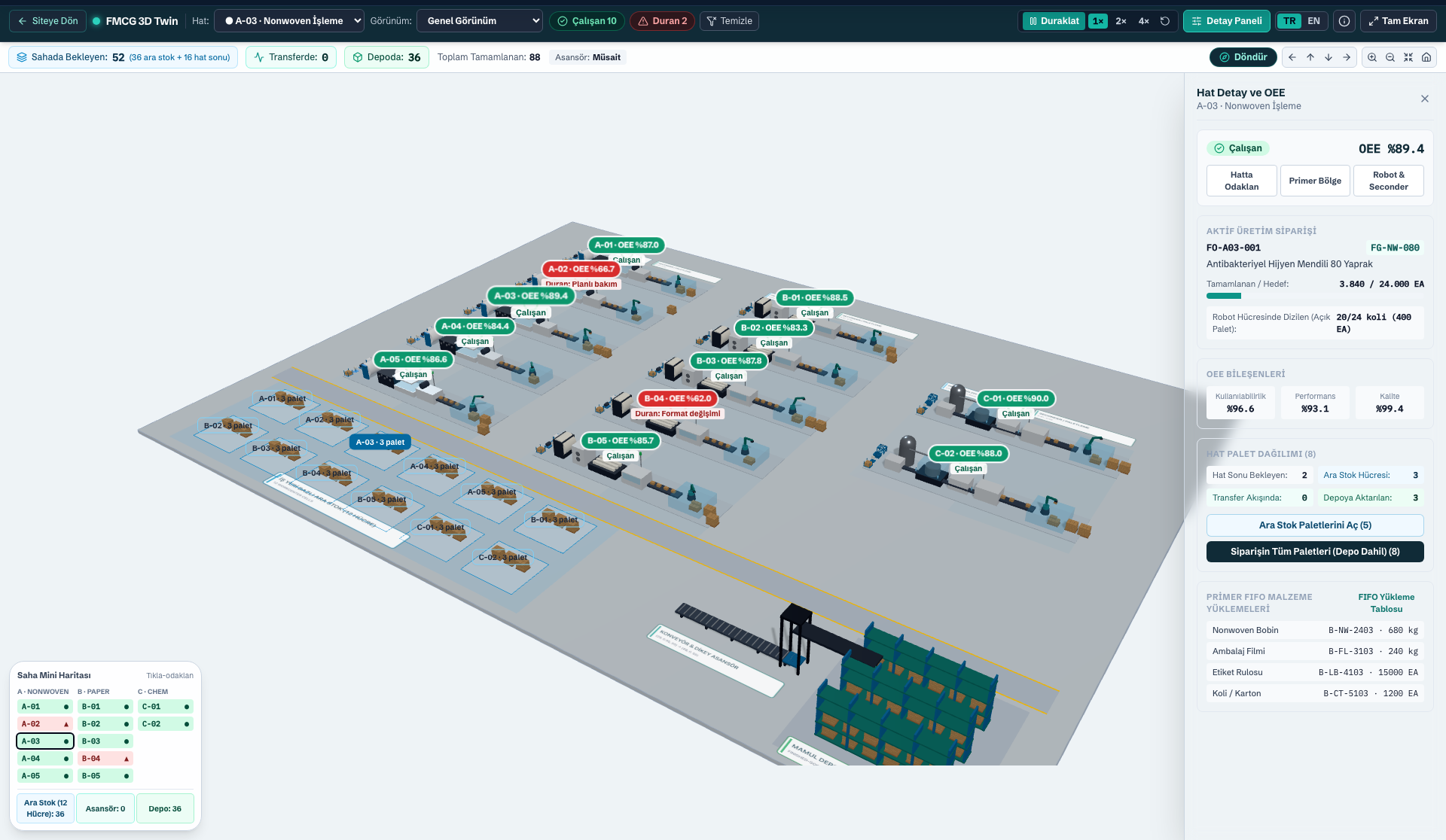
FMCG 12-Line Production & Pallet Logistics 3D Twin
DIGITAL TWIN · 02FMCG · 12 High-Speed Lines & Pallet Logistics

FMCG 12-Line Production & Pallet Logistics 3D Twin

12 converting and filling lines across 3 machine families (Nonwoven A-01..05, Paper Converting B-01..05, Chemical Filling C-01..02), 6 FIFO material carrier geometries, robot palletizing, and 4-column lift transfer.

  • Overhead 3D OEE rings, 180s stop reason grace rule, and interactive minimap
  • 6 distinct 3D FIFO material carrier geometries behind primary infeed
  • 88 bootstrap pallets (52 waiting on floor + 36 in warehouse) and 144s cycle
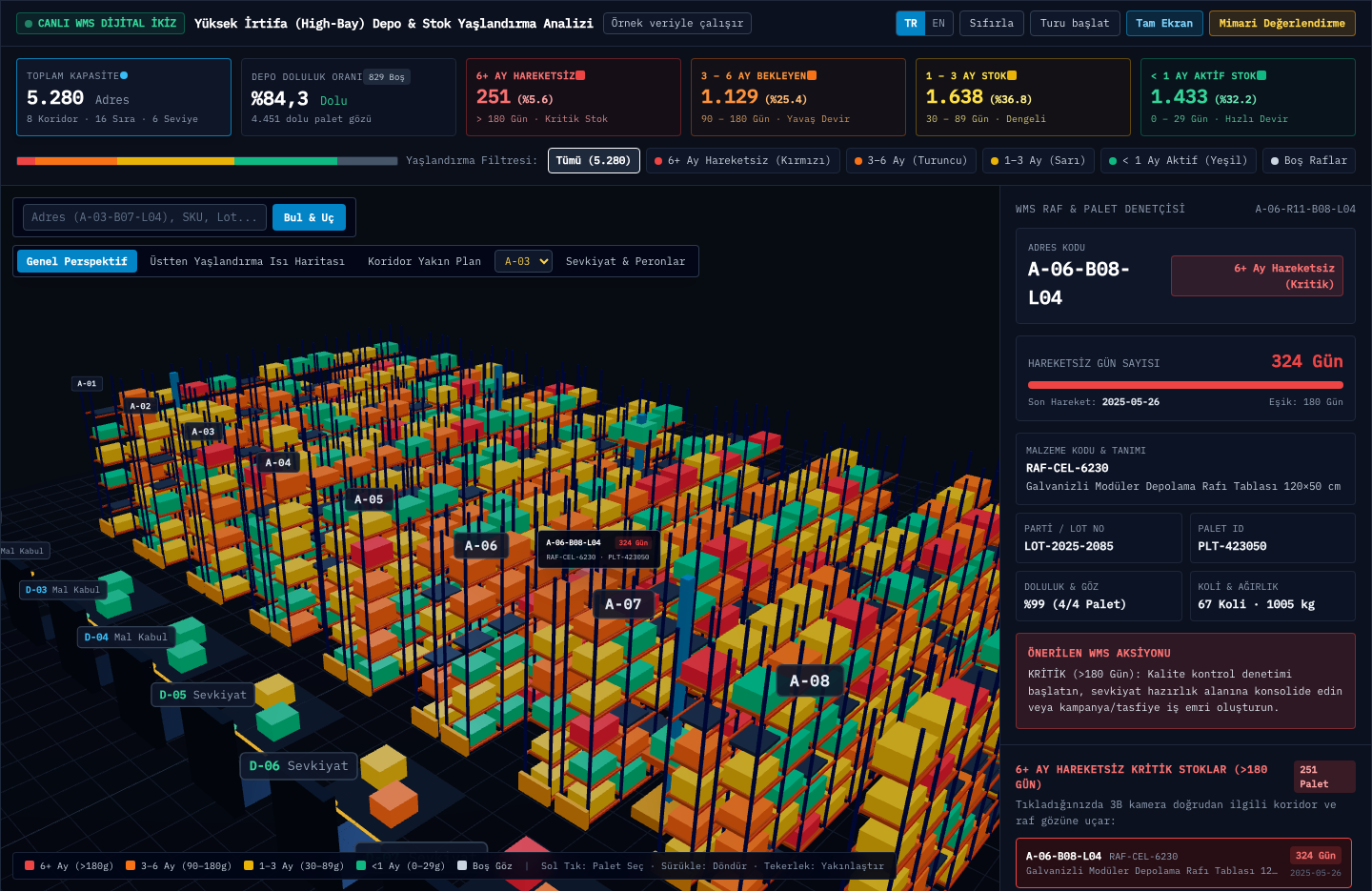
High-Bay 3D Warehouse & Stock Aging Heatmap
3D WAREHOUSE · 035,280 Bins · Non-Moving Stock Aging Heatmap

High-Bay 3D Warehouse & Stock Aging Heatmap

Analyze bin occupancy and non-moving inventory aging tiers across an 8-aisle, 16-row automated high-bay distribution center with stacker cranes (SRM) and receiving/shipping docks.

  • 6+ months critical non-moving stock (Red) & 3–6 months waiting stock (Orange)
  • 1–3 months normal stock (Yellow), < 1 month active turnover (Green), and empty bins
  • One-click aging tier dimming, aisle camera presets, and WMS inspection drawer
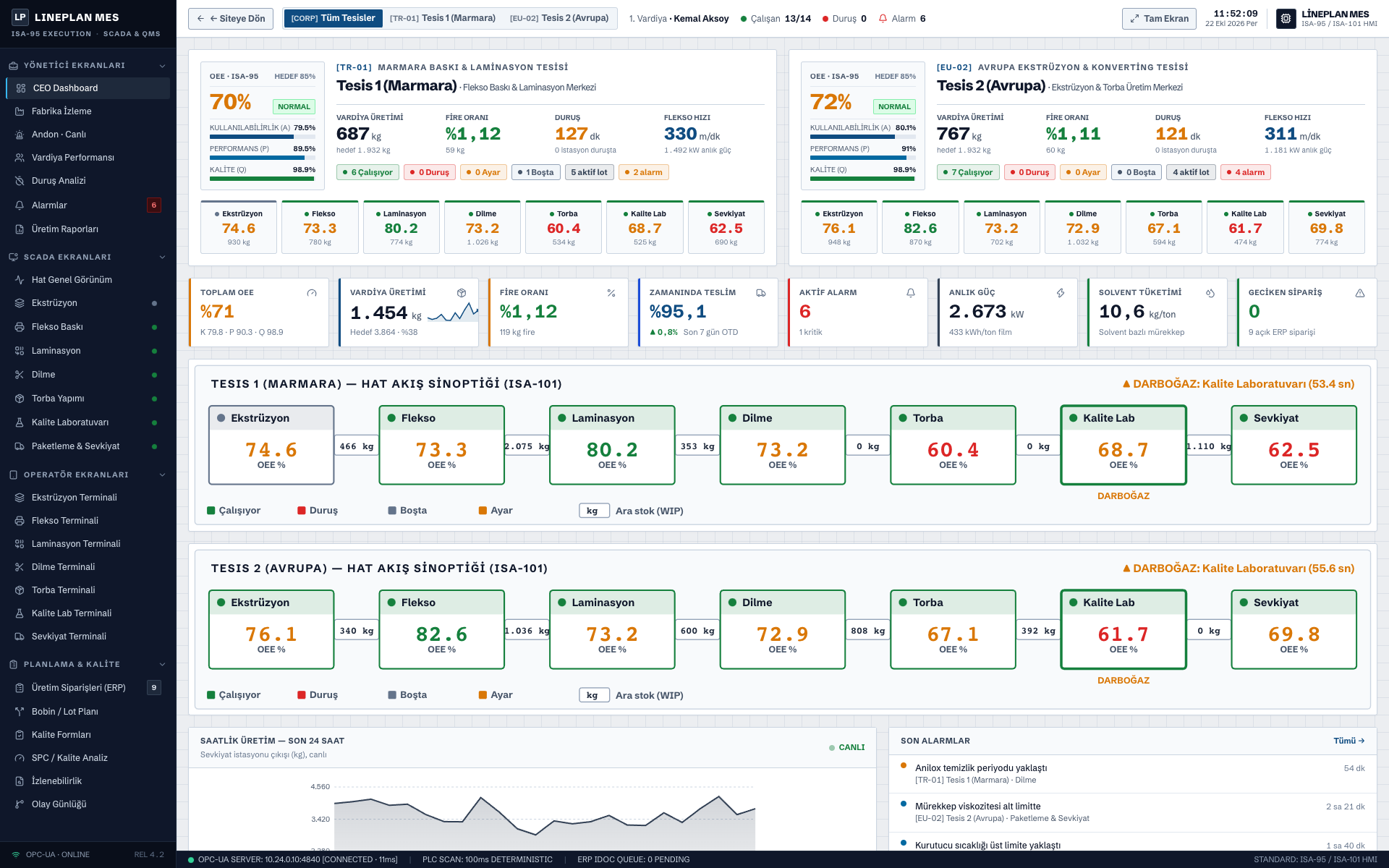
Enterprise MES, Live SCADA & Operator Execution Suite
ENTERPRISE MES · 0416 Screens · 2 Plants · 7 Stations SCADA & Quality

Enterprise MES, Live SCADA & Operator Execution Suite

16-screen industrial MES spanning CEO executive dashboards, plant monitoring, 7 station SCADA mimics, operator confirmation terminals, downtime analysis, quality forms, SPC charts, and lot genealogy.

  • Executive: CEO Dashboard, Factory Monitor, Live Andon, Shift & Downtime Analytics
  • Shop Floor & SCADA: Line Overview, 7 Station SCADA Mimics & 7 Operator Terminals
  • Planning & Quality: Production Orders, Reel/Lot Plan, Quality Forms, SPC & Traceability

02 — Module Scope

Operational Capabilities & Scope

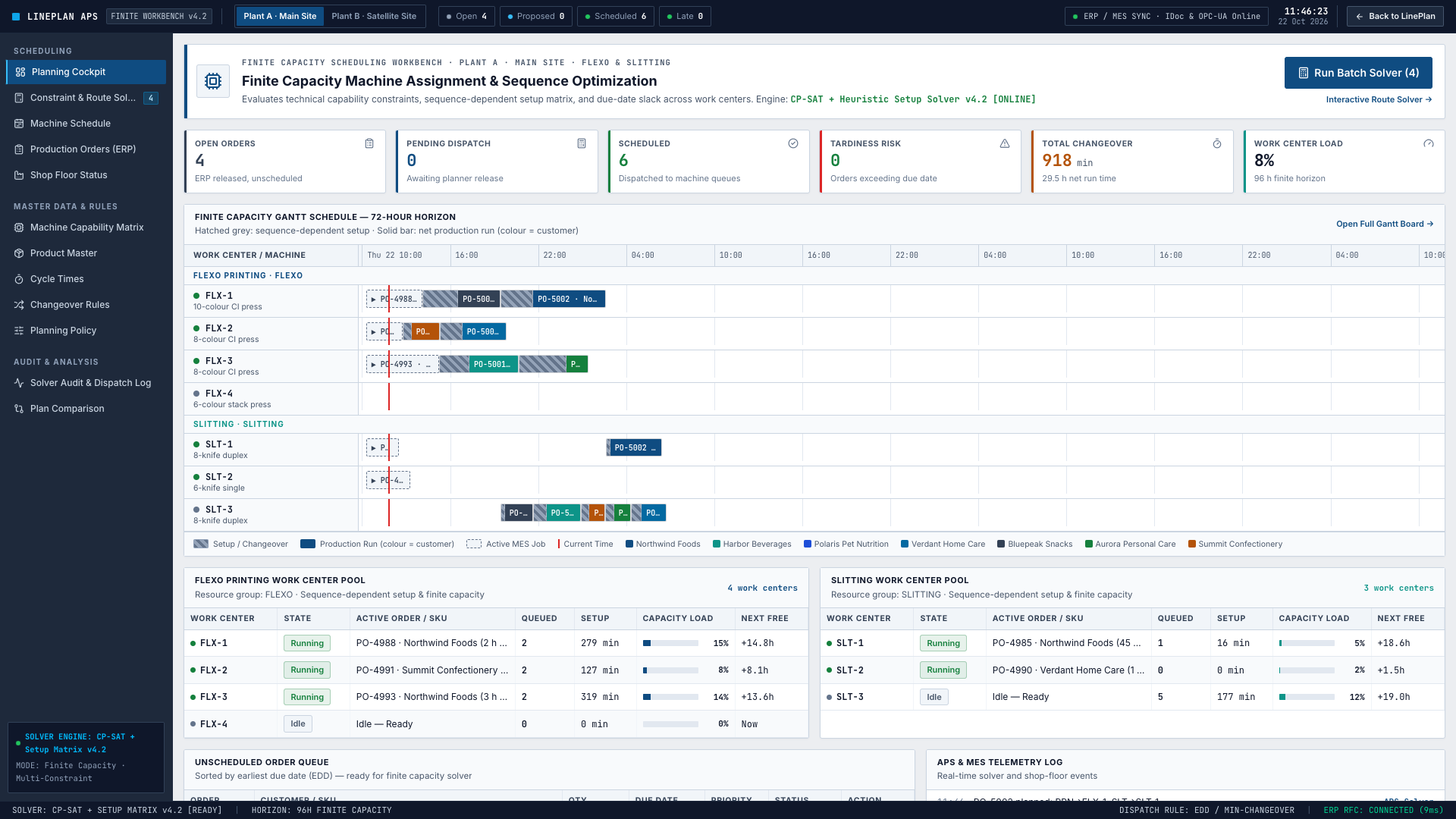
  • Finite Capacity and Constraint-Based Scheduling

    Machine availability, shift calendars, operator skills, tooling, and diameter/format transition constraints run in a single model. Setup durations and planned maintenance windows are embedded directly in the Gantt schedule.

  • Heat, Coil and Order Sequencing

    Reduces changeover losses by optimizing heat and section sequences in steelmaking, parent-reel slitting sequences in paper converting, and product-family transitions in FMCG packaging.

  • Scenario Comparison and Bottleneck Analysis

    Compare two planning scenarios side by side: total setup hours, delayed order count, work-center utilization percentages, and WIP waiting times.

  • Bidirectional ERP–MES Schedule and Actuals Flow

    Reads production orders from ERP, dispatches approved sequences to operator terminals, and reflects live shop-floor confirmations back onto the schedule.

  • Multi-Plant and Shift Calendar Governance

    Calculates shift patterns, planned stoppage windows, and alternative routing paths across multiple plants and production departments simultaneously.

  • BOM Component and FIFO Readiness Verification

    Verifies whether BOM components and FIFO batches are staged and sufficient behind the work center before an order is released to the floor.

Industries & Shop-Floor Applications

How Is the Shop Floor Managed Across Sectors?

Explore all sector architectures →
SECTOR 01Heavy Industry & Primary Metallurgy

Iron & Steel · Meltshop and Continuous Casting (CCM)

Heat-Based Meltshop Cockpit and Automated Consumption/Output Confirmation

Single-screen management of heat orders, ferro-alloy additions and cut billet confirmations across EAF/BOF, Ladle Furnace, Vacuum Degassing and Continuous Casting stations.

Spectrometer Laboratory Integration and Intermix (Mixed Casting) Control

Instant comparison of optical emission spectrometer chemical results against steel grade tolerances and automated segregation of transition billets during sequence casting.

Inspect 5-step shop-floor screen workflow→
SECTOR 02Heavy Industry & Hot Forming

Iron & Steel · Hot Rolling Mill, Reheating Furnace and Wire Rod / Bar Mill

Furnace Entry Camera Verification and Billet Charging Interlock

Camera and weigh-scale verification of billets fed by overhead crane into the reheating furnace, preventing mixed-heat charging and preserving traceability for damaged tags.

In-Furnace Billet Thermal Map and SCADA – MES Reconciliation

Live slot-by-slot mapping of all billets inside the reheating furnace by position, order, heat color code, zone temperature and furnace dwell time.

Inspect 5-step shop-floor screen workflow→
SECTOR 03High-Speed Process & Packaging

Fast-Moving Consumer Goods (FMCG) · Hygiene, Personal Care and High-Speed Packaging

Bulk Pallet Confirmation Engine and In-Memory FIFO Component Simulation

Single-action confirmation of multiple pallets during peak shifts with upfront FIFO component stock validation and automated label/posting orchestration.

Centralized Inkjet Coding and Mixer (Drop) – Line Traceability

Pairing solution batches prepared in mixer vessels with packaging lines and automatically driving line-mounted Inkjet printers from MES.

Inspect 5-step shop-floor screen workflow→
SECTOR 04Continuous Process, LGV & Converting

Paper & Converting · Tissue Paper, Parent Jumbo Roll and Converting Lines

Full Genealogy from Pulp Furnish Blend to Tambour, Parent Reel and Converting Pallet

Continuous material genealogy linking pulp blend ratios to Paper Machine tambour rolls, slit parent reels and finished converting pallets.

LGV (Laser Guided Vehicle) Reel Grouping and Autonomous Line Feeding Integration

Grouping heavy parent reels at the paper machine exit and dispatching LGVs for hands-free transport to intermediate storage and converting lines.

Inspect 5-step shop-floor screen workflow→
SECTOR 05Assembly Lines & Serial Production

Discrete Manufacturing · Home Appliances, Electromechanical and Automotive Tier-1

Station-Based Operator Panels (POD) and Real-Time Poka-Yoke Interlock Engine

Real-time station validation architecture that halts progression when an incorrect component is scanned or an upstream operation is incomplete.

Automated Test Booth Integration and Closed-Loop Rework Governance

Automated capture of electrical and functional test rig results with enforced closed-loop rework routing for failed units.

Inspect 5-step shop-floor screen workflow→
SECTOR 06Electronics & High-Granularity Traceability

Electronics, Surface-Mount (SMD) PCBA and Precision Device Manufacturing

Component Reel ID, Feeder Slot Interlock and MSD Moisture Floor-Life Governance

Verification architecture preventing wrong component reels from being loaded onto SMD feeders and blocking expired moisture-sensitive components.

AOI / Functional Test Integration and Complete Electronic As-Built Genealogy

Automated linking of optical and electrical test logs to board serial numbers and multi-level genealogy from component reel to final box-build device.

Inspect 5-step shop-floor screen workflow→

03 — Integration

Enterprise Integration Architecture

Integration ArchitectureBi-directional data exchange between ERP and MES; operator screens, Digital Twin and 3D Warehouse read from the shared data layer; PLC, SCADA and OPC UA signals feed the data layer.REST / OData / RFCLive Data StreamShared modelEnterprise ResourceERP System (PP / MM / WM)Orders · Inventory · Master dataManufacturing ExecutionMES & Business Rules EngineWork order · Confirmation · OEEUnified Record ChainShared Data LayerLive state & historical traceOperational InterfacesAPS & MES ScreensVisual Shop-Floor ModelDigital Twin & 3D WarehouseShop-Floor AutomationPLC · SCADA · SensorsIndustrial ProtocolsOPC UA · Modbus TCP · REST
Şekil 1 — ERP ↔ MES ↔ Shared Data Layer ↔ Digital Twin and 3D Warehouse

Data sources: ERP (REST / OData / RFC / Web Services), MES, PLC/SCADA/OPC UA, Level-2 Automation, JDBC, CSV/Excel import.

04 — Infrastructure & Architecture

Technical Specifications & Infrastructure

AttributeSpecification
EngineLinePlan APS constraint solver, sequence optimizer, and scenario simulator
IntegrationERP (REST / OData / RFC / Web Services), MES, CSV/Excel import-export
DeploymentCloud, on-premise, or hybrid
Data RefreshEvent-driven upon order change or shop-floor status update
Identity & AccessAD/LDAP, SSO, role-based schedule approval workflow
Live Simulationhttps://demo.lineplanai.com

05 — Delivery Methodology

Delivery & Commissioning Methodology

  1. 01Discovery: analysis of current planning workflow, changeover matrix, and capacity constraints.
  2. 02Data Mapping: ERP orders, work-center capacities, shift calendars, and inventory sources.
  3. 03Pilot: 1 product family or 1 production department within 3–6 weeks.
  4. 04Rollout: all lines commissioned with bidirectional ERP and MES write-back active.

06 — Corporate FAQ

Architecture & Delivery Processes (FAQ)

Yes. It communicates with your existing ERP via standard services and can also operate standalone using structured CSV/Excel imports.

07 — Architectural Assessment

Enterprise Architectural Assessment